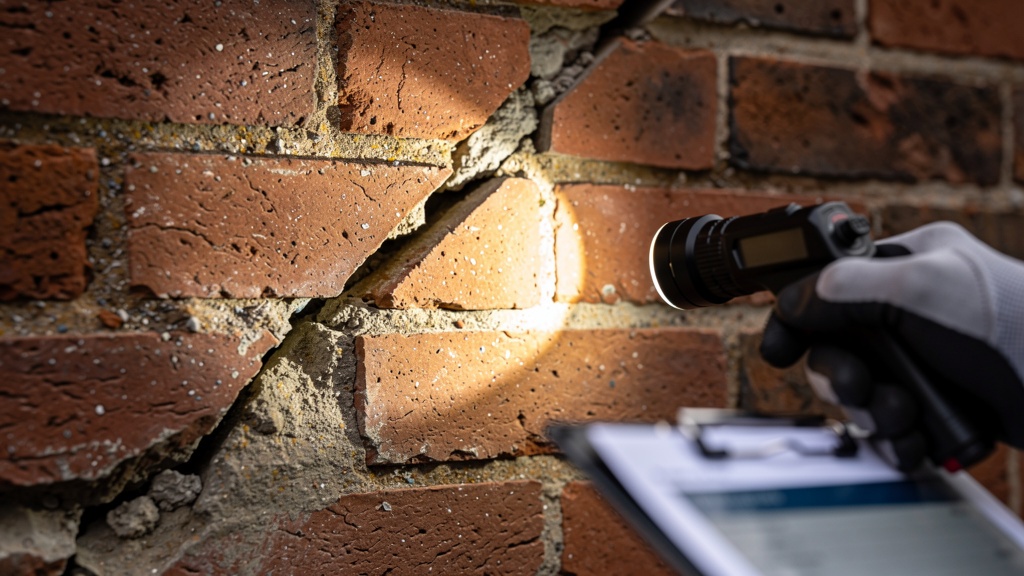
Discover a crack in the wall of a home you are viewing and the immediate instinct is often panic. Is this subsidence? Should I walk away? Will the house fall down? In the vast majority of cases, the answer to all three questions is no. But some cracks do signal genuine structural concerns — and knowing how to read the difference can save you from both unnecessary alarm and an expensive mistake.
At Esher Surveyors, cracks in walls feature in a very high proportion of the survey reports our RICS surveyors produce across Surrey. This guide is designed to give you the same understanding our surveyors apply on site — clearly, without unnecessary jargon, and without the scaremongering that sometimes surrounds this topic.
Why Do Walls Crack? The Main Causes
Before we look at types and severity, it helps to understand why cracks appear in the first place. The main causes fall into several broad categories:
Thermal Movement
All building materials expand slightly in warm weather and contract in cold weather. This creates small but cumulative stresses in walls, particularly in long runs of masonry, around window and door openings, and at the junctions between different materials (for example, where a brick wall meets a concrete lintel). The resulting cracks are typically fine, run horizontally or appear at stress concentration points, and are cosmetic in nature.
Normal Settlement
Every new building undergoes some degree of settlement as the ground beneath consolidates under the new load. In most cases, this process is complete within the first few years of a building's life. Minor cracking resulting from this initial settlement is extremely common and, in an older property, essentially irrelevant — the movement stopped a century ago. This type of cracking is typically found at internal plasterwork, around openings and in render on external walls.
Differential Settlement (Structural)
This is where the concern begins. Differential settlement occurs when one part of a building moves downward more than another — or in a different direction. This creates shear stresses in the structure which manifest as diagonal cracking, often following mortar joints in brickwork in a characteristic staircase pattern. The causes of differential settlement include subsidence (see below), inadequate foundations on variable ground, and poorly bonded extensions or additions.
Subsidence
Subsidence is the downward movement of a building's foundations due to changes in the load-bearing capacity of the ground beneath. It is the most serious cause of cracking and the one that commands the most attention — often rightly so, but sometimes disproportionately. In Surrey and the wider Elmbridge area, the main subsidence triggers are:
- Clay shrinkage — Surrey sits on significant deposits of London clay, which shrinks during dry summers and swells in wet winters. This cyclic movement is a leading cause of subsidence claims in the county.
- Tree root activity — roots from large trees (particularly oaks, willows and poplars near water) can extract moisture from clay subsoils, accelerating shrinkage beneath foundations.
- Broken drains — a failed drain beneath a building can leach water from the soil, or in some cases directly wash away fine material, undermining foundations. A CCTV drain survey can confirm or exclude this.
- Poor original foundations — older properties, particularly Victorian terraces in areas such as Surbiton and Thames Ditton, were built with shallow foundations relative to modern standards. These can be more vulnerable to ground movement.
Heave
The opposite of subsidence, heave involves upward movement of the ground — most commonly caused by clay swelling after a large tree is removed (which stops root moisture extraction), or following prolonged wet weather. Heave can cause horizontal cracking and upward displacement of floors and lower walls.
Lintel and Bearing Failure
Lintels carry the load of masonry above window and door openings. If they are inadequately sized, poorly embedded, or — in older properties — made from timber that has rotted, the masonry above can settle, creating characteristic cracking fanning out from the corners of openings. This is very common in Victorian and Edwardian properties.
The BRE Crack Classification System
RICS surveyors use the BRE (Building Research Establishment) crack classification system as a standard reference when describing cracking in survey reports. The system grades cracks from Category 0 to Category 5 based on width and the level of repair required:
- Category 0 – Negligible: Hairline cracks less than 0.1mm. No action needed.
- Category 1 – Very slight: Fine cracks up to 1mm. Generally cosmetic, easily filled.
- Category 2 – Slight: Cracks up to 5mm wide. May require repointing or general repair but not structural in nature.
- Category 3 – Moderate: Cracks between 5mm and 15mm. Some concern warranted; doors and windows may jam; remediation required but not necessarily an emergency.
- Category 4 – Severe: Cracks of 15–25mm, with possible displacement between wall faces. Extensive repair required; structural engineer involvement recommended.
- Category 5 – Very severe: Cracks over 25mm with significant structural disruption, displacement, and potential danger to stability. Requires urgent structural assessment and major remediation.
In practice, the vast majority of cracks our surveyors find in Surrey properties fall into Categories 0–2. Category 3 findings are not uncommon in older properties and do not necessarily indicate a serious problem. Categories 4 and 5 are relatively rare and will always result in a Condition 3 rating in our survey reports with a recommendation for further specialist investigation.
How to Assess a Crack: What Our Surveyors Look For
When our surveyors encounter cracking at a property, the assessment involves more than measuring the width. We consider:
Pattern and Direction
Horizontal cracks in brick or blockwork can indicate lateral pressure on a wall (for example, from failed cavity wall ties in the case of modern construction, or from retained earth pressing against a basement wall). Vertical cracks in the centre of a wall may indicate hogging (the middle of a wall rising while the ends subside). Diagonal staircase cracks are often associated with differential settlement. Cracks radiating from corners of openings suggest lintel issues or localised settlement.
Width and Displacement
Is one side of the crack higher or further forward than the other? Any displacement — not just width — is a sign of three-dimensional structural movement and warrants closer investigation.
Whether the Crack is Active or Historic
An experienced surveyor can often determine whether a crack is old and stable (perhaps filled and redecorated multiple times) or recent and potentially active. Fresh, unfilled cracks with clean, sharp edges suggest recent movement. Cracks that have been repeatedly filled, or where the surrounding plasterwork has old, discoloured patches, suggest a long history — which in itself is useful information.
Context Within the Property
A single crack in isolation tells you very little. A pattern of cracks — multiple diagonal cracks on the same elevation, cracking at multiple corners of the same room, sticking doors and windows in the affected area — builds a much more telling picture. Our surveyors always consider the totality of the evidence.
External Corroboration
We check the external elevation of the property for corresponding cracking, movement in chimneys, condition of the gutters and downpipes (leaking gutters can saturate ground near foundations), and the proximity and type of trees. We also note the local geology where relevant — properties on shrinkable clay, fill or made ground carry higher subsidence risk than those on chalk, gravel or rock.
When Does a Crack Require Action?
As a general guide, you should seek professional advice if:
- A crack is wider than 5mm (Category 3 or above)
- There is any displacement between the two faces of a crack
- A crack has appeared suddenly or is growing
- Multiple cracks have appeared at the same time
- Doors or windows in the affected area are sticking or have gaps
- A crack corresponds to other signs of movement (gaps at floor/ceiling junctions, sloping floors)
- There is a large tree near the affected wall
- You are about to buy the property and the estate agent cannot provide a clear history
What Does a Structural Survey Reveal?
Our RICS Level 3 Building Survey is the most thorough residential survey available and is specifically designed for properties where structural concerns are a possibility. During a Level 3 survey, our surveyors will:
- Inspect and classify all visible cracking using the BRE system
- Assess the context and likely cause of each crack
- Check for corroborating signs of movement both internally and externally
- Identify any trees, drains or other site factors that may be relevant
- Assign a condition rating (1, 2 or 3) to each finding
- Recommend appropriate follow-up action — whether that is monitoring, specialist investigation by a structural engineer, or a CCTV drain survey
If we find significant cracking, we will say so clearly in the report and recommend the appropriate next steps. We will not leave you with vague language — you will know exactly what we have found, what we think is causing it, and what you should do about it.
Subsidence Insurance: What Buyers Need to Know
Properties that have a history of subsidence typically have a note of this on their buildings insurance policy. When buying a property with known subsidence history, your conveyancer should obtain copies of any previous subsidence claims, engineering reports, and certificates of works carried out. Your insurer will need to be informed of this history.
Past subsidence that has been properly investigated, remediated (perhaps with underpinning) and monitored is not necessarily a reason to withdraw from a purchase. What matters is that the cause has been identified and addressed. A property with a properly documented and resolved subsidence claim is often safer, in terms of known history, than one where the cause of cracking has never been investigated.
Negotiating After a Survey Finds Cracking
If our survey identifies significant cracking, this gives you a clear basis for renegotiating the purchase price or asking the vendor to carry out further investigations or remediation before exchange. In cases of significant structural uncertainty, we may recommend a specialist structural engineer's report — the cost of this is almost always justified by the information it provides.
Our surveyors are happy to discuss the findings of our reports with clients and to advise on the likely cost ranges for further investigation and remediation. Please contact us after receiving your report if you have any questions.
Frequently Asked Questions About Wall Cracks
Are wall cracks in a house serious?
Not always. The vast majority of wall cracks in UK homes are superficial and caused by normal thermal movement, seasonal shrinkage or minor settlement that stopped years ago. Serious structural cracking is characterised by wide, diagonal patterns, multiple cracks appearing together, displacement between the two sides of a crack, and progressive widening over time.
What causes diagonal cracks in walls?
Diagonal cracks — particularly staircase cracks following mortar joints in brickwork — are often associated with differential settlement, where one part of the building moves more than another. This can be caused by subsidence, heave, or lateral movement. Not all diagonal cracks are serious; context, pattern and progression matter enormously.
What is subsidence and how do I know if my house has it?
Subsidence is the downward movement of a building's foundations due to changes in the bearing capacity of the ground beneath. Common causes in Surrey include clay shrinkage during dry summers, tree root activity, broken drains undermining foundations, and poorly compacted fill. Signs include diagonal cracks emanating from corners of windows and doors, doors and windows sticking, and cracks wider at the top than the bottom.
How do surveyors classify wall cracks?
RICS surveyors typically use the BRE classification system, grading cracks from Category 0 (hairline, less than 0.1mm) to Category 5 (very severe, greater than 25mm). Categories 0–2 are generally cosmetic or minor and require monitoring. Categories 3–5 indicate progressively more serious structural concerns.
Should I buy a house with cracks?
In many cases, yes. Minor cracking that has been stable for many years is extremely common in older UK properties and is typically cosmetic. However, it is essential to commission a RICS Level 3 Building Survey before proceeding, and to ensure that any active or significant cracking is thoroughly investigated before exchange.
What is the BRE crack classification system?
The BRE Digest 251 classification system grades cracks from Category 0 (negligible hairline cracking) through to Category 5 (very severe structural cracking requiring major repair or rebuilding). It is the standard reference used by RICS surveyors when describing crack severity in survey reports.
Concerned About Cracks in a Property You're Buying?
A RICS Level 3 Building Survey from Esher Surveyors will give you a thorough, honest assessment of any cracking — with clear condition ratings and practical recommendations. We cover Esher, Surbiton, Cobham, Walton-on-Thames and the whole of the Surrey area.
Book a Level 3 Survey Level 3 Survey DetailsSources: BRE Digest 251: Assessment of Damage in Low-Rise Buildings; RICS Building Surveys and Technical Due Diligence of Commercial Property (4th edition); Institution of Structural Engineers: Subsidence: Repairing Damage to Buildings; Building Research Establishment GBG33: Repairing Brick and Block Masonry.