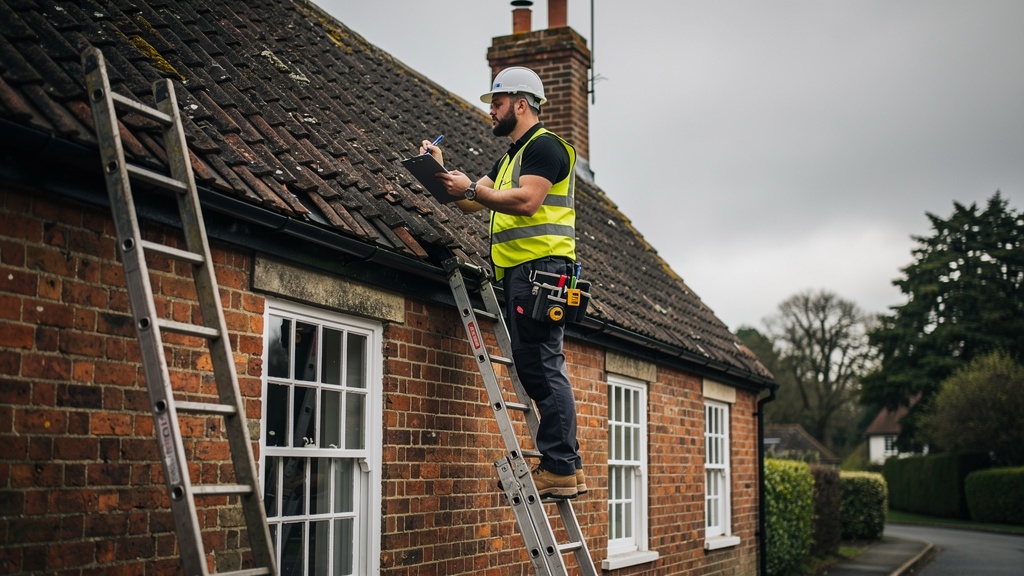
Of all the elements of a property survey, the roof is arguably the most important. It's the primary defence against the elements. When it fails — whether gradually through aging or suddenly through storm damage — the consequences ripple through the whole building. Water ingress damages ceilings, walls, insulation and structural timbers. Remediation gets expensive fast.
And yet, buyers often underestimate roof condition because, frankly, it's not something you can assess from a quick viewing. From the street or the garden, a roof might look perfectly fine — only a trained surveyor, using binoculars, a ladder and a thorough inspection of the accessible roof space, can properly evaluate what's actually going on up there.
What We Look For Externally
The external roof inspection begins at ground level. Using binoculars, we assess the overall coverage — looking for slipped, cracked or missing tiles or slates. We look at the ridge line: is it straight? A sagging ridge can indicate structural movement in the roof timbers.
We then look carefully at the chimneys. In Surrey, where period properties with multiple chimney stacks are common, this is often the most critical part of the external inspection. Failed flashings — the lead or code sheeting that seals the junction between the chimney stack and the roof covering — are one of the most common causes of water ingress in older properties. Deteriorated pointing around the chimney stack itself is another frequent finding.
Other key external elements we assess include:
- Verges and eaves: Are the mortar bedded verges (the edges at the gable end) intact? Are the eaves tiles/slates correctly fixed?
- Gutters and downpipes: Overflow, blockage, sagging, missing sections and incorrect fall are all noted. Blocked gutters are a surprisingly common cause of damp in wall heads.
- Flat roofs: Any flat roof section over an extension, bay window or outbuilding is inspected closely for signs of ponding water, blistering, cracking or failed joints.
- Velux windows and roof lights: Lead soakers and flashings around these are a common failure point, particularly on older installations.
The Roof Space Inspection
For a RICS Level 3 building survey, we access the roof space wherever this is safely possible. The roof space inspection is, in many cases, the most revealing part of the entire survey. Hidden from everyday view and rarely visited by homeowners, roof spaces often tell a story that the finished ceiling below cannot.
What are we looking for in the roof space?
- Evidence of water ingress: Staining on rafters, sarking felt or the underside of tiles, or damp insulation, indicates past or ongoing leaks.
- Structural timber condition: We check rafters, purlins, ridge boards and ceiling joists for rot, woodworm and adequate sizing. Undersized timbers, or timbers weakened by insect attack, can be a serious structural concern.
- Chimney breast condition: The internal face of chimney stacks in the roof space often shows staining and deterioration that isn't visible anywhere else.
- Insulation: We note the type and depth of insulation and advise where it's inadequate for current standards.
- Ventilation: Inadequate roof space ventilation leads to condensation on the underside of the roof covering — which in turn leads to rot in the timbers and potentially premature failure of the roof covering itself.
"I once entered a roof space in a 1930s semi in Surbiton that looked perfectly fine from the street. The sarking felt had long since deteriorated, there was significant woodworm in the rafters, and someone had repaired a leak by stuffing the gap with expanding foam. The roof needed complete replacement. The buyers negotiated a substantial reduction and proceeded — with eyes wide open."
Common Roof Defects in Surrey Properties
Based on surveys across the Esher, Surbiton, Claygate and wider Elmbridge area, the most common roof-related findings include:
- Failed or deteriorating lead flashings to chimneys and valleys
- Slipped or missing natural slate tiles (on Victorian and Edwardian properties)
- Failed flat roofs over extensions (particularly felt-based systems over 15 years old)
- Blocked gutters causing persistent overflow and damp at wall heads
- Condensation and rot in roof space timbers due to poor ventilation
- Woodworm in roof timbers (most often active in older, uninsulated spaces)
What Does Roof Repair Actually Cost?
Costs vary enormously depending on the issue. Replacing a small section of flashing might cost £300–£500. A full re-roofing of a Victorian semi in the Surrey area — stripping and replacing the slate covering with new tiles or reclaimed slates — typically runs from £8,000 to £18,000 or more depending on size and material choice. A failed flat roof over an extension might cost £2,000–£6,000 to replace with a modern single-ply or GRP system.
These are significant numbers — and they're precisely why roof condition is one of the most important things your survey will address.
Frequently Asked Questions
Worried About a Roof? Let Our Surveyors Take a Look.
Our RICS surveyors carry out thorough roof inspections as part of every building survey across Esher and Surrey.
Book a SurveyRelated reading: Surveying Period Properties | Thermal Imaging in Surveys | RICS Level 3 Building Survey