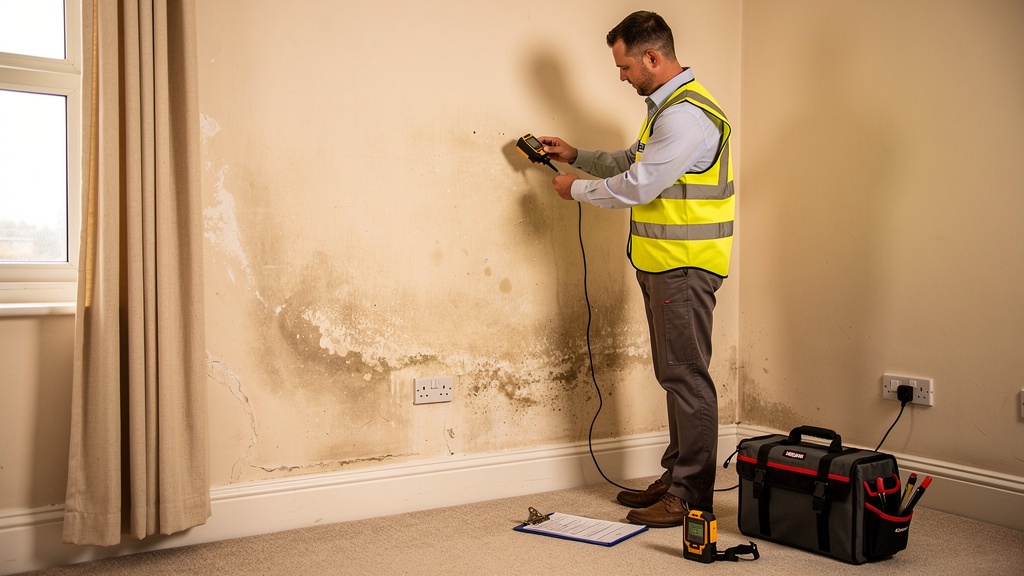
Damp is the word that strikes fear into the hearts of homebuyers and homeowners alike. Find it on a survey report and many people immediately start worrying about thousands of pounds of remediation, structural damage, and health risks. In reality, the picture is nearly always more nuanced — and far more manageable — than that.
At Esher Surveyors, damp-related observations appear in a significant proportion of the survey reports we produce across Surrey. Most are not catastrophic. Some are little more than a poorly positioned plant pot against a wall or a bathroom without adequate ventilation. Others do warrant professional attention. This guide will help you understand the difference.
The Three Main Types of Damp: What Our Surveyors Find in Surrey Homes
Before you call in a damp specialist — and certainly before you spend money — it helps to understand which of the three main categories of damp you are dealing with. Each has different causes, different visual signs, and different solutions.
1. Condensation Damp
This is by far the most common form of damp in UK homes, and it is frequently misdiagnosed as rising or penetrating damp by untrained eyes. Condensation occurs when warm, moisture-laden air meets a cold surface. In a poorly ventilated bathroom, kitchen or bedroom, that cold surface is usually an external wall or a window frame.
Signs to look for:
- Black mould growth, particularly in corners, on window sills and around cold bridges such as wall ties
- Misting or streaming on windows in the morning
- A musty smell, especially in wardrobes against external walls
- Damp patches that appear in cold weather and improve in summer
Condensation is a lifestyle and ventilation issue first and a building defect second. In many older properties across Esher and the wider Elmbridge area, older cavity walls and solid Victorian walls can create significant cold bridges. The solutions — better ventilation, positive input ventilation (PIV) fans, improved heating patterns — are usually modest in cost.
2. Penetrating Damp
Penetrating damp is caused by water entering the building through a defect in the external fabric. This could be a cracked render on a 1930s semi in Surbiton, a failed pointing in a period brick wall, a leaking gutter, a damaged flashing around a chimney stack, or a faulty window seal. Water travels horizontally through the wall, which is what distinguishes it from rising damp.
Signs to look for:
- Damp patches on walls that correspond to external features (e.g., directly below a window, beneath a parapet, next to a downpipe)
- Damp patches that worsen during or after rain
- Staining or tide marks on plasterwork
- Efflorescence (white salt deposits) on brick or stonework
- Damp on ground-floor and upper-floor walls alike
The key to fixing penetrating damp is finding the source of water ingress and repairing it. In most cases, that is a relatively straightforward job for a skilled roofer or builder. Our Level 3 Building Survey will identify the likely source, give you a condition rating (1, 2 or 3), and recommend the appropriate specialist trades.
3. Rising Damp
Rising damp is groundwater travelling up through the base of a wall by capillary action. It is most commonly found in older properties without a functioning damp-proof course (DPC), or where the existing DPC has failed or been bridged.
Signs to look for:
- A consistent tide mark on lower wall sections, typically no higher than 1 metre from the floor
- Plaster that is peeling, crumbling or hollow-sounding when tapped
- Heavy salt deposits on the lower sections of walls
- Rusting skirting board fixings
- Damage concentrated at ground-floor level only
It is worth noting that true rising damp is much less common than the damp-proofing industry might suggest. Multiple independent studies — including work by the BRE (Building Research Establishment) — have concluded that a significant number of "rising damp" diagnoses are actually condensation or penetrating damp. A RICS-qualified surveyor can help you get an honest, impartial assessment.
How Esher Surveyors Assess Damp During a Property Survey
During a RICS Level 2 Home Survey or Level 3 Building Survey, our surveyors carry a calibrated moisture meter and probe all accessible wall surfaces, particularly at ground-floor level and in areas where visual signs suggest moisture. We record moisture readings, note the pattern of any dampness, and cross-reference this with the external condition of the building — checking gutters, downpipes, pointing, render, flashings and external ground levels.
This combination of internal and external inspection means we rarely miss the underlying cause. We will describe any damp findings using the RICS condition rating system:
- Condition 1 – No repair is currently needed. The property must be maintained in the normal way.
- Condition 2 – Defects that need repairing or replacing but are not considered serious or urgent.
- Condition 3 – Defects that are serious and/or need to be repaired, replaced or investigated urgently.
A moisture reading that is slightly elevated in a ground-floor room of an older Surrey home is unlikely to be rated Condition 3 unless there is clear evidence of active ingress, damage to structure or a pattern consistent with rising damp. We will always explain our findings in plain English — not alarm you unnecessarily.
Thermal Imaging and Damp: The Modern Approach
One of the most significant advances in damp detection in recent years has been the widespread adoption of thermal imaging cameras by qualified surveyors. By showing temperature differentials across a wall surface, a thermal camera can highlight areas of moisture retention that are invisible to the naked eye — and in some cases, to a moisture meter held only at the surface.
At Esher Surveyors, we offer thermal imaging as part of our Level 3 Building Survey package. It is particularly valuable for older or complex properties where damp pathways may be difficult to trace by conventional means. You can read more about our approach in our article on how thermal imaging is changing property surveys in Surrey.
Common Damp Issues We Find in Surrey Properties
Having surveyed hundreds of homes across Esher, Claygate, Cobham, Walton-on-Thames, Surbiton and the wider Elmbridge area, certain patterns emerge. Here are the most common damp-related findings in our reports:
Victorian and Edwardian Solid-Wall Terraces
These properties — plentiful in areas like Surbiton and Thames Ditton — were built without cavity walls and without modern DPCs. They often have slate or engineering brick DPCs that can be effective but may be bridged by raised external ground levels, garden borders, or accumulated debris in subfloor voids. Condensation is also extremely common because solid walls have poor thermal performance. Our guide to surveying period properties covers this in more detail.
1930s Semi-Detached Houses
The cavity wall construction of the interwar period was meant to solve the damp problems of earlier eras — and largely it did. However, these properties often feature rendered external walls, and where that render has cracked or failed, water can track through to the inner leaf. Failed cavity trays around window heads and chimney stacks are another common culprit.
Flat-Roof Extensions
Flat roofs have a limited lifespan. We frequently find failed felt or mineral-felt roofs on rear extensions in Surrey homes, leading to penetrating damp in the room below. If your extension is more than 15 years old and has a flat roof, a proactive inspection is worthwhile.
Basements and Lower-Ground-Floor Rooms
Below-ground rooms are inherently vulnerable to moisture, particularly in areas with a high water table or where external ground levels are elevated. Many Surrey homes that have been converted to provide basement living space will have tanking applied to walls — and tanking systems can fail over time.
How Much Does Damp Remediation Cost in Surrey?
One of the most common questions we are asked is: "If the survey finds damp, how much will it cost to fix?" The honest answer is: it depends enormously on the type and extent of the problem. Here is a rough guide to typical costs in the Surrey area:
- Improved ventilation (extractor fans, trickle vents): £150–£500
- Positive input ventilation (PIV) unit: £400–£800 including installation
- Gutter cleaning and repair: £150–£400
- Repointing brickwork (one elevation): £800–£2,500
- Chimney flashing repair: £300–£800
- Chemical DPC injection and re-plastering (one room): £1,500–£3,500
- Flat roof replacement (small extension): £2,000–£5,000
- Basement tanking (per square metre): £50–£100 per m²
If a survey report flags damp, always get at least two to three quotes from reputable, independent contractors. Avoid using the specialist recommended by a vendor or estate agent — instruct your own tradesperson. And remember: some damp-proofing contractors have a commercial incentive to recommend the most expensive solution. An independent RICS surveyor has none.
Negotiating on Price After a Damp Finding
A damp finding on a survey report can give you legitimate grounds to renegotiate the purchase price. If our survey identifies penetrating damp caused by a failed flat roof, for instance, we can provide a cost estimate for remediation. You can then request a price reduction — or ask the vendor to carry out repairs before exchange — based on that figure.
This is one of the most tangible financial benefits of commissioning a proper RICS survey rather than relying solely on the mortgage lender's valuation. A mortgage valuation is not a survey: it will not detect damp unless it is blindingly obvious, and it offers no detail on repair costs.
What to Do If Your Existing Home Has Damp
If you already own the property and suspect damp, we would recommend the following steps:
- Commission an independent inspection — an RICS surveyor or a PCA (Property Care Association) member, not just a free damp-proofing survey from a contractor.
- Identify the type — do not proceed to remediation until you know what you are dealing with.
- Address the source — fixing a leaking gutter costs a fraction of replastering a room.
- Check ventilation — before anything else, make sure the property is properly ventilated.
- Get independent quotes — use PCA-registered contractors and get at least two quotations.
If you are unsure where to start, our team at Esher Surveyors is always happy to advise. We offer a range of survey and consultancy services and can often point you in the right direction without needing to conduct a full survey.
Damp and Your Health
Persistent damp and mould growth are associated with respiratory health issues, particularly in children, elderly people and those with asthma or compromised immune systems. The NHS advises that damp and mould can cause or worsen respiratory conditions, and that the spores from black mould (Stachybotrys chartarum) can be particularly problematic in enclosed spaces.
This does not mean that a damp property is automatically a health emergency — but it is a reason to take the matter seriously and act promptly. Improving ventilation, treating mould growth with appropriate fungicidal wash, and addressing the underlying cause will typically resolve health-related concerns alongside the structural ones.
Preventing Damp: Our Top Practical Tips
Whether you are buying or already own a property in Surrey, prevention is always better and cheaper than cure. Here is what our surveyors recommend:
- Clean gutters and check downpipes at least once a year (preferably in autumn)
- Keep external ground levels at least 150mm below the DPC level
- Ensure bathroom and kitchen extractor fans are working and used consistently
- Avoid drying clothes on indoor radiators without ventilating the room
- Check roof flashings and chimney pointing every five years
- Do not stack garden debris, logs or soil against external walls
- Ventilate wardrobes on external walls and avoid overfilling them
- Check subfloor air bricks are clear and not blocked by paving or raised beds
Frequently Asked Questions About Damp in Surrey Properties
What are the three main types of damp in UK homes?
The three main types are rising damp (groundwater travelling up through walls), penetrating damp (water entering through defects in the building fabric) and condensation damp (moisture in warm air depositing on cold surfaces). Each has different causes, patterns and remedies.
How much does damp treatment cost in Surrey?
Costs vary significantly. Condensation issues can often be resolved with improved ventilation at low cost. Penetrating damp repairs typically range from £500–£3,000 depending on the source. Rising damp chemical injection treatments range from £800–£2,500 for a typical room. A full re-plastering after damp treatment can add £1,000–£2,500 per room.
Can a RICS survey detect damp?
Yes. A RICS Level 2 or Level 3 survey includes a damp check using a calibrated moisture meter on all accessible walls. Our surveyors also carry out a visual assessment for damp staining, efflorescence, tide marks and mould. Thermal imaging can be added to our Level 3 surveys for enhanced detection.
Should I buy a house with a damp problem?
Not necessarily. The type, extent and cause of the damp matter hugely. Condensation issues are rarely a deal-breaker. Penetrating damp from a blocked gutter is usually an easy fix. Rising damp in a solid-wall Victorian terrace may require more significant remediation. Our surveyors can give you a clear view of costs and risks before you commit.
What is a damp and timber survey?
A damp and timber survey is a specialist inspection that assesses both moisture levels throughout a property and the condition of any exposed or accessible timber (including floor joists, roof timbers and lintels). It is often commissioned after a RICS survey flags concerns, and is usually carried out by a specialist contractor — though our surveyors can advise on what is needed.
Concerned About Damp in a Property You're Buying?
Our RICS surveyors serve Esher, Surbiton, Cobham, Walton-on-Thames, Thames Ditton and the wider Surrey area. A Level 2 or Level 3 survey will give you a full picture of any damp issues — and the information you need to negotiate or plan repairs with confidence.
Book a Survey View Our ServicesSources: BRE (Building Research Establishment) Good Repair Guide 33: Treating Rising Damp in Houses; RICS Home Survey Standard 2021; NHS England Guidance on Damp and Mould in Housing; Property Care Association (PCA) Code of Practice.