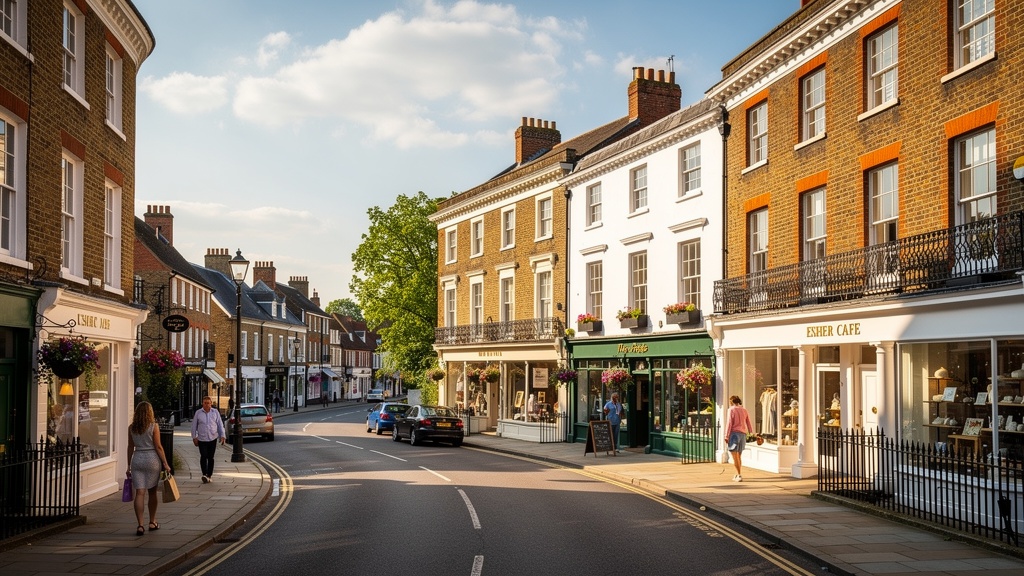
I've carried out surveys across the Esher area for the past decade, and I can tell you from first-hand experience: this is one of the most varied and fascinating property markets in Surrey. On one street you'll have a 1970s bungalow, three doors down a Victorian villa, and across the road a modern new-build. They all look inviting. They all carry risks. And each one needs a different approach from a surveyor.
If you're buying a property in Esher — or even just thinking about it — this guide will give you a realistic picture of what to expect: the market, the property types, the common issues, and why getting a survey matters so much in the KT10 postcode.
Why Esher? Understanding the Property Market
Esher sits in the heart of the Elmbridge borough in Surrey, roughly 14 miles south-west of central London. It's served by trains into London Waterloo, it has Sandown Park Racecourse on its doorstep, and it borders the beautiful Esher Common. For families, professionals and retirees alike, it ticks a lot of boxes.
The Esher property market is firmly at the premium end. Average prices in the KT10 postcode consistently rank among the highest in Surrey. You'll find everything from compact one-bedroom flats near the station to multi-million-pound detached homes set back from leafy lanes near the Common.
What drives demand? Good schools (both state and private), proximity to the M25 and A3, and a village atmosphere that somehow coexists with excellent amenities. The affluent nature of the area also means properties are generally well-maintained — but "well-presented" doesn't always mean "structurally sound."
The Property Types You'll Encounter
One of the things that makes the Esher property market so interesting — and so important to survey carefully — is the sheer variety of stock. As a buyer, it helps to know what era of construction you're dealing with:
- Victorian and Edwardian homes (pre-1914): Found mainly in the older parts of Esher village and along certain roads near the railway. These need a RICS Level 3 building survey almost without exception. Solid walls, slate roofs and timber floors all require specialist attention.
- Inter-war housing (1920–1939): Characterised by pebbledash render, tiled roofs and cavity walls. More modern in approach but still with their own set of issues — particularly around render condition and aging services.
- Post-war housing (1945–1970): A range of construction types, some experimental. Non-traditional construction — prefabs, no-fines concrete, system-built homes — can appear in this era and requires specific investigation.
- Modern homes (post-1980): Generally more straightforward structurally, though quality of construction varies enormously. A Level 2 home survey is often appropriate here.
- Riverside cottages near the Thames: Some of the most characterful — and challenging — properties in the area. Age, proximity to water, and unusual construction methods all factor in.
Common Issues We Find in Esher Properties
After hundreds of surveys in and around Esher, certain issues come up again and again. Knowing what to look out for won't replace a professional survey — but it will help you ask better questions:
- Damp and condensation: Solid-wall Victorian properties are prone to penetrating damp. Poorly ventilated post-war homes often suffer from condensation-related mould. Both are common and both are worth investigating properly.
- Roof condition: Aging clay or concrete tiles, failed flashings around chimneys and dormers, and deteriorated flat roofs over extensions are among our most frequent findings across the KT10 area.
- Drainage: Esher has some older drainage infrastructure. We often recommend CCTV drain surveys for older properties to check for root ingress, collapse or incorrect connections.
- Clay soil movement: Surrey clay is notorious for shrink-swell behaviour. Properties on heavier clay soils — particularly near the Common and in parts of KT10 — can be susceptible to subsidence and heave. We always look carefully at crack patterns.
- Extension quality: Many Esher homes have been extended over the decades. Quality of extensions varies hugely. A poorly built rear extension can introduce damp, structural weakness and thermal bridging.
"The most expensive survey we ever did in Esher cost the buyer around £750. It identified subsidence movement that had been filled and painted over — twice. The property needed underpinning. The survey saved the buyer an estimated £60,000."
Do You Need a Survey in Esher?
With average property prices in KT10 regularly exceeding £700,000–£800,000, the answer is almost always yes. The fee for a RICS survey represents a tiny fraction of the purchase price — but the information it provides can be worth many times that amount.
In a competitive market where buyers are sometimes pressured to move quickly, it can feel like a risk to insist on a survey. But the bigger risk is proceeding without one. We've had clients ring us after exchange, having skipped the survey to speed up a purchase, who then discovered significant defects during renovation works. At that point, you have very limited legal recourse.
Which Survey for Esher?
For most period properties in Esher — and that's a significant proportion of the housing stock — we recommend a RICS Level 3 building survey. For modern homes in good condition, a Level 2 is usually sufficient. Not sure? Call us — we're happy to advise before you commit to a booking.
Frequently Asked Questions
Buying a Property in Esher? Talk to a Local Surveyor First.
We know the Esher property market inside out. Get a free, no-obligation quote from our RICS surveyors today.
Get a Free QuoteSee all the areas we cover or explore our full range of surveying services.